
AI for Campground Operators: A People-First Approach
The tools are ready. The question is whether your team is.
AI adoption is spreading fast across outdoor hospitality — and most of it is quietly set up to fail. Not because the technology isn't powerful. Not because the tools are too complex. But because too many operators are treating AI as a software challenge when it's really a people challenge.
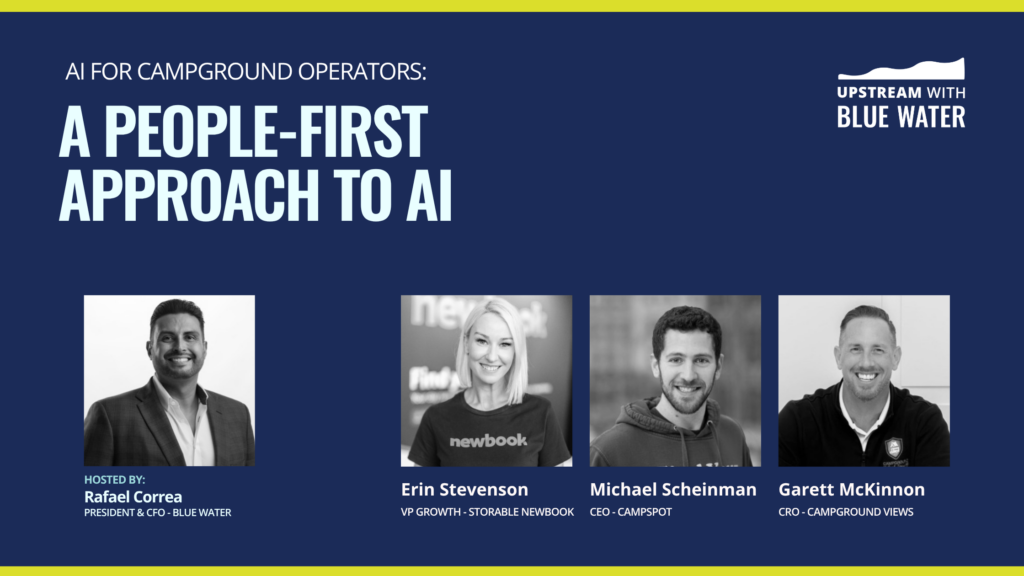
That was the defining takeaway from Blue Water's recent LinkedIn Live roundtable, "Tech Driven Future: AI in Outdoor Hospitality." Erin Stevenson of Storable Newbook, Michael Scheinman of Campspot, and Garett McKinnon of Campground Views joined Blue Water's own Rafael Correa, President & CFO, to share what's actually working — and what isn't — as operators across the country navigate one of the most significant business shifts in recent memory.
Here's the good news: this is one of the most solvable challenges your business will face.
Treat AI Like a New Team Member
Erin Stevenson, VP of Growth & Customer Experience at Storable Newbook, put it simply:
“We look at it as if AI is like onboarding a new team member. For the past few months, we’ve worked at encouraging our employees to really understand the way that AI works as their initial base.”
The outdoor hospitality operators seeing real, measurable results with AI aren't the ones with the biggest budgets or the most sophisticated tools. They're the ones investing intentionally in their people — helping their teams understand what AI is, how to use it effectively, and where it adds the most value to their day-to-day operations.
They treat AI adoption like onboarding, because that's exactly what it is.
And critically, they understand that AI isn't here to replace their people. In an industry built on personal connection, on the warmth of a check-in conversation and the feeling of being truly welcomed, AI works best as a support system. The goal is to elevate your team, streamline back-of-house operations, and create more memorable guest experiences. Not to remove the human touch that makes outdoor hospitality what it is.
Set Boundaries Before You Scale
Michael Scheinman, CEO of Campspot, offers a useful way to think about it: AI is like a talented but inexperienced new hire. These tools can handle tasks that once required human time and attention — but you wouldn't hand a first-week employee your guest database or put them in charge of complex operational decisions.
The same logic applies here.
Before you scale anything, pause and define what AI should — and shouldn't — be responsible for in your business. That clarity is what separates operators who are getting real value from AI from those who are cleaning up expensive mistakes.
When approached with that kind of intention, AI becomes a genuine support system. And this industry stays what it's always been: people-driven.
You Don’t Have to Rush
Garett McKinnon, CRO of Campground Views, said it best: take a breath and slow down. We’re all learning this together. Whether you run one campground or an entire portfolio of properties, the process is the same — only the scale is different. What matters most is giving your team the time and space to grow along the way.
AI Adoption Checklist for Outdoor Hospitality Operators
Whether your team is five people or fifty, the approach is the same:
- Start small:
- Look at what your team does every single day. Find the repetitive, low-lift tasks and start there — not with your most complex problems.
- Build a culture of learning:
- Make AI education part of your regular rhythm. Share tips in team meetings, run short trainings, and keep a running list of useful prompts. Tools will keep evolving — but a team that's comfortable learning will keep pace with them.
- Set data guardrails early:
- Define what information should never be entered into an AI tool — especially guest data like emails, booking details, and payment information. It's far easier to set those guardrails now than to address a breach of trust later.
- Lead with confidence, not pressure:
- Don't push your team to use AI just to check a box. The goal is adoption that sticks — people using these tools because they trust them and see the value firsthand. That starts with leadership modeling the behavior.
At the end of the day, AI should work for your people — not replace them. The operators who get this right won't just run more efficient properties. They'll build stronger teams, deliver better guest experiences, and be better positioned for whatever comes next in this industry.
Did you miss the discussion? Watch it here: LinkedIn Live with Blue Water, Campspot, Campground Views, and Newbook leaders.
For more information about Blue Water and its portfolio of award-winning properties, visit www.bwdc.com.